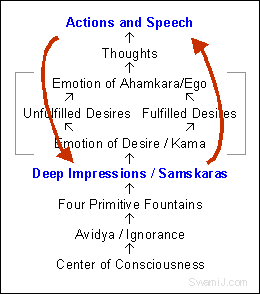
Breaking the Karmic Cycle

Friday, October 5, 2012

The ancient yogis believe that through our lifetime(s) we play out a continuous cycle of action and the deep impressions that come from that action. In this way we relive similar scenarios of our lives over and over again. These actions (karmas) and impressions (samskaras) are so deeply rooted in our heart/mind center of consciousness (citta) that they come with us even as we reincarnate. The only way to break the cycle from continuing in the same way in thousands of different scenarios is to recognize that the patterns exist. And then to do a bunch of work by meditating and changing the flow of your energy (prana) so that you may form a healthier approach to the pattern.

This is heady stuff. And know that the above paragraph is very much "pop" yogic philosophy. But it's just a tiny introduction to get you familiar with the idea of:

We act (karma)----->> an impression is formed (samskara)---->> we act again (karma)


With the second round of our action, we have the choice to act even more from a point of a deeply rooted pattern or to recognize our tendencies and change the course of our action.

Here is a real life example:
I am someone who moves quite frequently. Every couple of years, I pack up all my stuff and forge a new life. Each time I move, I become more independent of my old self, develop new ideas from meeting new people and having new experiences, and discover more and more that I am the only person who can make myself happy. Okay, all well and good.
So, every couple of years, before I move, I come back to my hometown and re-assess. Or, the point would be to re-assess, but what plays out instead is a classic karma/samskara loop. It doesn't matter one bit how much work I've done on myself in my last city, how clear it was becoming to me that I am the center of my own happiness, how healthy I have been eating, none of it matters.
I get home and I start the loop. Go out too often, drink too much, butt-heads with my mom, put off visiting my grandmas, have the impression that someone else is going to be the thing that makes me happy. Over and over. It's like an embarrassing broken record.
And why?

These patterns are down in there deep. The first step to breaking from the norm of your karmic cycle is to recognize that it exists. You have to begin to notice yourself playing out the same situations in a variety of settings.
Examples could be
1. Your emotional reactions to certain stimuli (are they always the same rise to anger or instant sadness or extreme joy?)
2. Avoidance of, or head on confrontation to conflict (do you react the same way every time you have a head-to-head?)
3. Your habits whether they be bad or good (why do you continuously bite your nails or insist on an orderly household or take the same route to work every day?)
It's all about discovering why it is that we do the things we do.

And then maybe you can sit back and watch as, like clockwork, you get back on the same old horse and do it all over again. And perhaps, after you do that fifty or a hundred times, it may become clear that a change is necessary. Changing a habit pattern or a pattern of action is step two. A pretty simple way to approach this step is to try giving up a habit pattern that you know is not in your best interest. And when you find yourself doing it, take a moment of contemplation and try to understand why your habit pattern is getting the best of you. And then maybe you can decide whether or not the habit pattern should continue.

The point is that we have the capability to make changes. But we have to recognize that the process of uncovering our patterns and changing them effectively takes a fair amount of work. And I personally believe that it's worth it.
Next time I go back to my hometown, I can assess all over again.

Practice is the Salve

Thursday, August 23, 2012

Thanks to my lovely friend, teacher, and general yoga inspiration Theresa Murphy, I have a title for today's post. My phrasing was "thank goodness for practice" but she took it to the next level. Deep bow for that.

So, those of you who know me probably know that I'm currently in a transitional phase (to put it kindly). My relationship of over five years ended rather suddenly and I was left a bit grasping for how to go on in my life. Being an adventure seeker combined with a big-time family gal, I opted to move several thousand miles away from my current home to live near my sister. So within the span of just two months I have experienced some heartbreak, the challenge of relocating and a whole lot of packing.

You should even practice when you go to India!

The main thing that I have been consistently grateful for throughout this period is my daily time on the mat and the cushion. My practice never even skipped a beat. Through all this personal turmoil I had the ability to find an hour or two of sweetness and stillness every day.

A month ago I went on vacation and saw a good friend of mine. She asked what it is that I'm doing for myself to get through this difficult time. I was at a loss for words, temporarily lost in the thought that perhaps I wasn't doing anything for myself when she interrupted my thoughts to remind me of my practice. It was at that point that I realized how reliant I am on my personal mat time and how much a part of me and my life it truly is. I feel blessed to have a disciplined skill set during this time.

In the future when I look back on this time in my life, I'll be able to do so with integrity and grace because I kept it real for myself. Practice is the salve for me.

Yoga in Action: Finding Joy in the Process

Thursday, August 2, 2012

We are so "finished pose" oriented in this country. Nobody wants to be the schmuck who doesn't look like B.K.S. Iyengar in their one-handed handstand, right? It's pretty common to see an intense amount of strain from a student who just isn't ready to go deeper.
I always try to give a few options of steps along the way to a peak pose--something like, "your first option is to work pigeon pose, when you're ready, you can add pigeon with the thigh stretch and for those of you who are quite open in your shoulders, you might try eka pada raja kapotasana."

Inevitably these initial suggestions go unexplored. Everyone jumps directly into what they perceive to be the "final posture." They cram their legs and arms into extreme angles, forgetting entirely to breathe, or to be present or to find any joy in this process of yoga. And this is how injuries happen and this is how people come to the conclusion that they "aren't good at yoga." 

The process of joy in this one took some work.
When I went to India to study with the Mohan's (see a post on that here) I was struggling between an orientation that was largely based in asana (posture) and one that was more interested in the movement of prana (life force/energy). I had just come off a week-long tantra intensive that was very um, intense in the pranic realm. I had ruffled my accrued lifetime of yucky stuff (karma) and wasn't really sure of how to best proceed.

The man himself, Krishnamacharya
The Mohan's are like the most pragmatic yogis that you've ever met. They teach Yoga Therapy as developed by Krishnamacharya. You know that guy? The one who taught all the modern day masters?

Ganesh, the son of the Mohan's, is trained as a medical doctor and an ayurvedic doctor. So yeah, he's pretty into wellness. And he happens to be one of the best teachers I've ever had. This is why--he's incredibly thorough and every single thing that he instructs is based on breath. The reason that you would go to a yoga therapist and not a physical therapist is because yoga connects to the breath and it creates an energy (prana) in the body that you don't get from doing exercises alone.
Breathe! Be present! Find joy in the process!

That's the rub, people. The reason that yoga works isn't because people with flexible hamstrings have more fun (bumper sticker?). It's because yogis who practice regularly just automatically start to slow down and experience more of life. When you base your practice on your natural cycle of breath, and you really really pay attention, you can't help but be more aware. And when you become more aware, it's easier to realize to all of the beautiful things that exist in a day, or in a moment!
And in my experience it becomes easier to appreciate small things at first and then larger things like being alive, and having friends and family and the fascinating world.

The process of yoga is a process of tracking down joy--true inner joy that can only come from you. The next time you're in class and your teacher gives you options, maybe try the first, fully connected to your breath and fully connected to a sense of joy before moving on to step two.

Breaking from Daily Practice

Tuesday, July 17, 2012

Every time I go on vacation, I suddenly become someone who doesn't meditate. And every single time I feel annoyed with myself and lazy. And I feel less good in my brain and my emotional realm than normal. And I spend all day thinking, "I'll just do this one thing, and then I'll meditate."

So why in the hell can't I bring myself to do it? At home I am exceedingly disciplined, bordering on rigid, making time for meditation no matter what. Which brings the obvious point to mind--it's part of my routine and my day wouldn't be normal or complete without it. But if it makes me feel so sane and so joyful why not just do it?

Me, on vacation, meditating!
Yesterday I returned to my routine from a ten day hiatus, having traveled with my family and friends in Colorado. I did find sporadic opportunities to meditate while there, and some days were as good as any day on my cushion at home. But yesterday I got to sit on my cushion, with my mala, and read the Yoga Sutras and do my chanting, and do the whole routine, free from the eyes and ears of all.
Oh my. I spent the entire time with a giant smile on my face.

But I wouldn't have had quite the same experience, had I not taken a few days break. This break gave me the opportunity to reflect on how much I appreciate my practice and how good it feels as a part of my day. I think taking breaks from any constant thing that we do is a key to enjoyment of that thing. Now this observation may seem like a cop-out from someone who can't bring themselves to meditate while on vacation, however! the point for me is that I did come back to my cushion and will continue to do so regardless of missing days. And when I did come back, it felt like coming home.

Breaking from asana practice is also useful. It can be hard to recognize progress without stepping back to reflect and enjoy your effort. Every week I take at least one or two days to enjoy my morning without practice. Sometimes it's hard to step away, it can make me feel lazy or make my body feel stiff. But most of the time I am grateful to have a break and to enjoy the fruits of my labor with a morning to myself.

This is part of a larger practice of letting go. Accepting what is as it comes and learning to live joyfully regardless. Surrendering to the flow of life when necessary, and coming back to your cushion with regularity and devotion.

Slowing Down with the Breath

Thursday, June 21, 2012


In the previous post (which you can find here: breath) I talked about several different approaches to thinking about the breath. For the next few posts, I will explore practical applications of some different breathing techniques and styles.

This post is specifically about ways to use the breath for calming, restorative, relaxing effects. If you tend to be someone who has trouble sleeping or relaxing, these techniques are ideal for you.

In slow, low to the ground practices of yoga, the simplest way to establish a calming and ground breath is to elongate the exhale. So if you count the beats of your breath and establish an even ratio, you would then lengthen out the exhale breath. Make sure to keep it sustainable--you don't want to end up with a 12 count exhale so that you're begging for the next inhale breath. I typically work with a 4 beat inhale to a 6 or 8 beat exhale in my personal practice.
Additionally, you can direct the exhale breaths downward, as though you're going to breath out of your pelvic floor. This type of breath corresponds with apana vayu which is a way to move energy toward elimination and grounding. So, in this type of breath, I inhale in and down from my nostrils to the pit of the belly and exhale from the belly out of the pelvic floor. Ten of these breaths will have you grounded in no time.
This breath work is most effective in slower styles, so it's perfect for these styles:

Yin Yoga (super long holds of five to ten minutes with passive stretching; intended to lengthen the connective tissue and to increase the flow of prana in the body)
Restorative (passive, relaxed long-held poses designed to "restore" the body)
Slow Flows (vinyasa styles with slower movement, longer exhales help to stay present and calm)
Meditation (deepening the breath can be effective in remaining present with your meditation)

Breathing this way is also ideal for the start of your savasana. It's a great way to get you tapped in to some grounding slowing energy before you drop in.
It's also perfect for falling asleep or falling back to sleep in the middle of the night. I find that just counting the pulses of my breath is automatically relaxing. Try this: roll on to your right side--this will encourage the flow of breath through the left nostril which is the yin calming side. Focus the breath on the left nostril, so try and breath solely in and out of the left and then use the technique above to lengthen the breath. I personally don't last long at all when I do this style of breath in the middle of the night.

One more thing to mention is a yoga style which combines slower breath with visualization.  
Yoga Nidra is yogic sleep which leaves the body and mind totally refreshed and renewed. It's fantastic. Here's a link to some practices on YouTube: yoga nidra

Happy Practice!

Breath of Life: Pranayama

Monday, June 4, 2012

Breathing like a MoFo
Isn't it kind of awesome that breathing counts as doing yoga? Well...let me be specific. Awareness of your breath and breathing in a purposeful way counts as doing yoga. Hurray!

There are so many components to breath that it can be hard to choose a main focus.

Am I concerned with the anatomical and physiological aspects of the breath?
In that case, I could talk about the movement of the diaphragm, the muscular support from the thoracic cavity, the role of the spine, potential positions of the tongue and throat, oxygenation of the blood and cells, etc.

If I want to focus on breathing in meditation, then I would be concerned with breath as a tool for concentration, controlling the breath to be even and equal, breath retention, lengthening inhales or exhales for achieving certain outcomes; again potential for lengthy and heady dialogue.

I think one of the loveliest things about the breath worth discussing here is its magnificent simplicity coupled with its enormous complexity. Ah yoga, you slay me with your dualities. In its simplest form, breath is just one inhale followed by one exhale. This pattern repeated over and over thousands upon thousands of times is our life-sustaining mechanism. No breath, no life. At its most complex, breathing performs so many functions for the body that it's overwhelming to consider them all.

The ancient yogis were aware of the energetic potential of breath and devised exercises to use it for the purposes of enlightenment. These complex ways to move breath are out of the scope of this current post but the fact that breath has such a capability is certainly worth noting. Using breath in this way--controlling, moving energy, containing--is what is known as pranayama which is the fifth limb of raja yoga.

The breath is one bodily function over which we have control. Think about it, you can't control your heartbeat or your digestion, but you can direct your breath to an area of the body, lengthen or shorten it, be a belly breather or a chest breather, and practice any number of types of pranayama. Isn't that completely fascinating and moves you to get out there and get your breath on?

In the coming posts, I intend to explore some specific ways to breathe so that you may have a more aware, more present and more healthful existence.
See you then.


Momentum

Monday, May 7, 2012

Have you ever noticed that when you consistently come to your mat or your cushion on a daily basis that it gets easier and easier to continue to do so? My teacher Theresa Murphy suggests that you come to your mat everyday, even if it's just for ten minutes.
This past week, I found myself low on the inspiration and drive totem pole. This happens to me often after I have an especially inspired practice or class. I'm not sure what it is....some little part of me feels that I've made an accomplishment and now I can retire.
Perhaps I will retire to India?
So, this past week I felt a bit like I was dragging myself to the mat. And then essentially rolling around on the mat because I couldn't muster up the impetus to practice any sequencing. Each day I'd come up with a list of things that I had to do before practicing (checking my email, drinking tea, folding my laundry, rechecking my email) but each day, even though it felt like a drag, I ended up on my mat and then my meditation cushion.
I do believe that this sort of slow down happens to everyone. It's pretty impossible to be "on" all the time and can actually be quite useful as a time for reflection to not quite "turn off" but at least turn down. Roll around on your mat (actually I was doing a lot of sensory awareness training also known as somatics), keep it low key and appreciate the times when I do feel the urge to do a badass practice with meticulous sequencing.
Being on the backside of last week, I feel grateful for making my way matward, even if only for a few moments. by doing so, I retained my sense of forward momentum and trust fully that inspiration will head my way before too long.

Santosha Sounds All rights reserved © Blog Milk Design Powered by Blogger